FDA approved labs
Nationwide testing centers
No appointment needed
Court-admissible results
Rapid Response24/7 commercial incident response
Built for the who owns the incident phone.

Built for Designated Employer Representatives (DERs), safety directors, safety managers, EHS managers and directors, fleet managers, fleet safety managers, HR directors and managers, risk managers, compliance managers, operations and terminal managers, dispatch supervisors, workers' compensation and claims leads, owners and principals.

Who takes your 2 a.m. call?

Every other DOT test runs on your calendar. Post-accident runs on the crash's calendar: 11:40 p.m., a county where nothing is open, a supervisor holding a phone while three clocks run.

Report it once. We run the clocks. You keep the record.

Keep your existing DOT program and TPA. We only take the incidents.
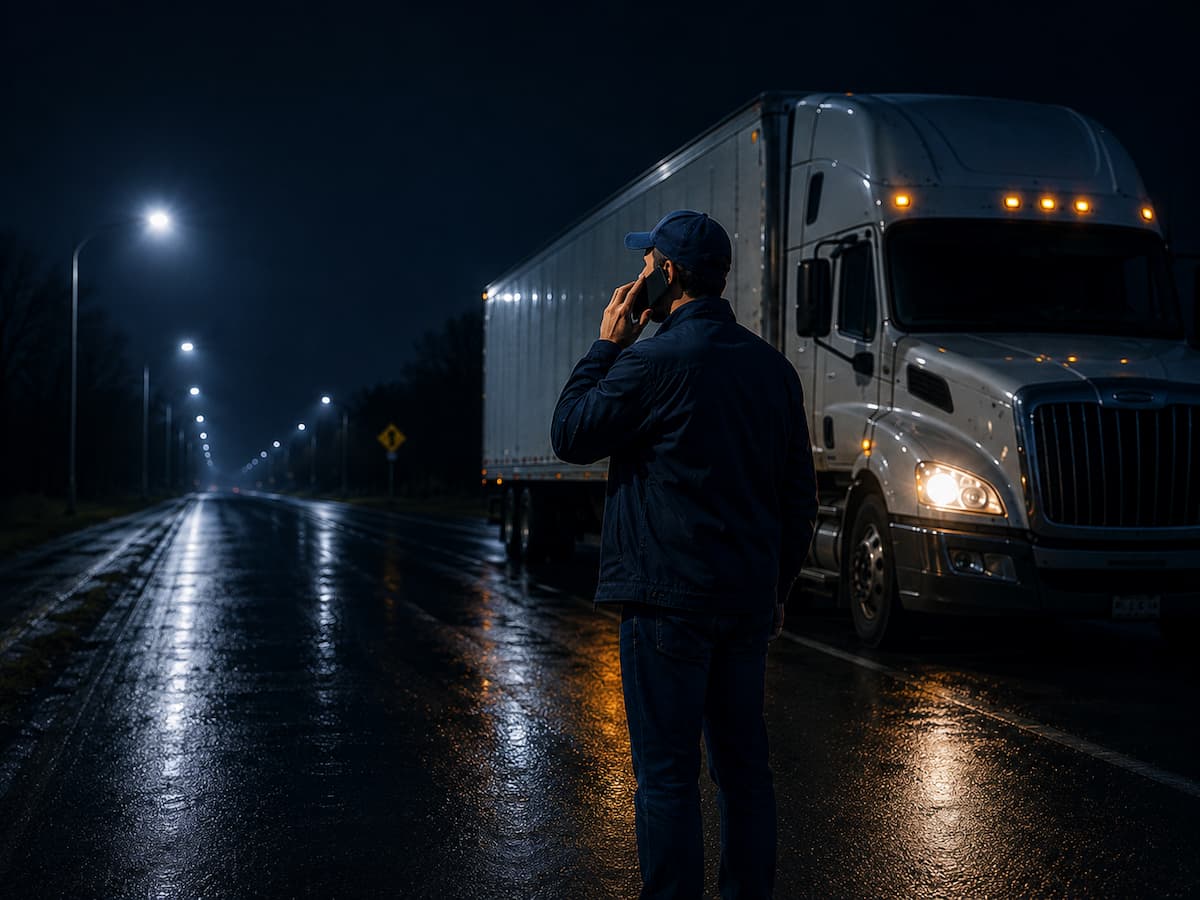
Illustration of a DOT-regulated commercial vehicle crash scene, with a supervisor on the phone and a clock showing elapsed time
2hr
Alcohol: attempt
8hr
Alcohol: cease
32hr
Drug: collect

The windows under 49 CFR §382.303. Miss one without a paper trail and the gap becomes the record.

Large trucks in crashes across the U.S. today
0
Since midnight, local time. Estimated at the federal published rate: roughly one every 60 seconds.
Next estimated0:60
The gap

Every DOT test is scheduled. Except the one that schedules you.

This is how safety teams describe it to us, in their own words.

“We have an established DOT program that handles pre-employment, random, and other required screenings. However, we cannot reliably meet the regulatory timeframes for post-accident testing following serious incidents in-house.”

EHS team, national engineering firm · inbound inquiry, 2026
Two ways to work with us

Buy the program, or build it into your platform.

For employers
Rapid Response Fleet
  • Keep your DOT program, TPA, MRO and random pool exactly as they are
  • 24/7 intake, DOT and non-DOT applicability determination
  • Nationwide collector coordination, day or night
  • Case tracked through MRO verification, documentation to your file
  • No subscription. Fund an account from $995 and we draw against it
Activate your program
For platforms & partners
Rapid Response API
  • Telematics, ELD, dashcam AI, fleet software, claims and FNOL systems
  • One endpoint turns a crash alert into a coordinated response
  • We handle Part 40 compliance, collectors and the record
  • Brokers, workers' comp TPAs and consultants can refer or private-label
  • Free to integrate during the pilot
See the API
How it works

Rapid Response in 3 steps

Your supervisor stays with the incident. We run the clock.

1

Report it once

Call, text, or an API event from your telematics platform. One report opens the case and starts the timestamped record.

2

We coordinate everything

Applicability determined, nearest qualified collector located and confirmed, driver directed, supervisor updated, every clock tracked.

3

You get the record

Chain of custody, results, MRO verification and the full incident timeline, delivered to your file and ready for an audit.

See a full incident walkthrough →
A real case shape

A 2 a.m. incident, tracked to closure

Representative case log. Times are elapsed from the moment your team reports the incident.

Case log · CDL driver · post-accidentChannel: call, text, or API
T+00:00Incident reported. Case opened.Location, driver and incident facts captured at intake.
T+00:04Applicability determined: §382.303 criteria met.Drug and alcohol testing both required. Clocks armed.
T+00:21Qualified collector confirmed, 6 miles from scene.Driver directed, supervisor notified, backup collector on standby.
T+01:03Breath alcohol test administered.57 minutes inside the first-attempt window.
T+02:00Alcohol first-attempt window closes
T+01:38Urine specimen collected, chain of custody signed.More than 30 hours inside the drug-collection window.
ClosureTracked through lab and MRO verification. Documentation delivered.If a window cannot be met, the required documentation is completed on time instead. Either way, you are covered.
What you're actually buying

Every incident becomes a defensible record

Eighteen months from now, in an audit, a claim dispute or a deposition, the question is simple: what did you know about the driver's condition, and can you prove it? The test is the method. The record is the product.

When the test happens
The file exists

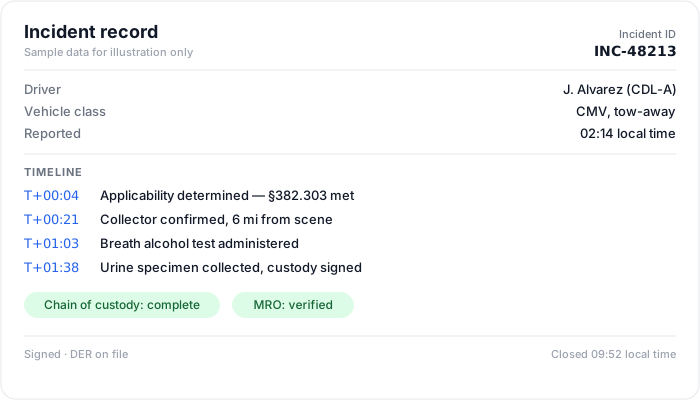
Intake timestamp, applicability determination, chain of custody, result, MRO verification, every clock met and logged. Our dispatch times are part of it: the timeline itself is what proves diligence.

When it can't
The file still exists

If a window cannot be met, the rule requires documenting every attempt, on time. A documented attempt protects you. A silent gap becomes an inference against you. We close every incident with a record, never a hole.

Example incident record with timestamps and chain of custody, anonymized sample data

The 2-hour window exists because the evidence destroys itself: alcohol metabolizes at a known rate. Rapid was never about convenience. It is about evidence integrity.

How it's funded

The delay isn't finding a collector. It's getting paid at 2 a.m.

Post-accident collection is normally paid at the time it is ordered, before anyone is dispatched. That means a call to someone at your company who can authorize a card, in the middle of the night, while the two-hour alcohol window runs down.

Pay-at-dispatch · the usual path
T+0:00Supervisor reports the incident.
T+0:06Collector identified.
T+0:06Payment required before dispatch. Who has a card?
T+0:41Someone with authority is finally reached and pays.
T+0:47Collector dispatched.
Funded account · Rapid Response
T+0:00Incident reported by call, text or API.
T+0:04Applicability determined, clocks armed.
T+0:07Cost drawn from your balance. No authorization call.
T+0:11Collector dispatched and confirmed.
You see the charge in the morning, itemized.
Illustrative. The point is not that we find collectors faster. It is that nobody has to be woken up to approve a payment before one moves.

You fund an account, we draw against it as incidents happen, and it tops itself back up. There is no subscription and no annual fee: the balance is your money, spent only on your own incidents.

What draws from the balanceCost
Post-accident drug screen
Collection, FDA-cleared or SAMHSA-certified laboratory analysis, and MRO verification
$105
Breath alcohol test
Qualified BAT, confirmation where required
$75
After-hours or mobile collection
When no fixed site is open or reachable. Billed at actual cost.
$150–300
Incident intake and coordination
Applicability determination, collector dispatch, clock tracking, the record
Included

Your pre-employment, random, return-to-duty and follow-up testing stays exactly where it is, with whoever handles it today. Nothing here replaces that program.

Opening balance
$995 minimum

Roughly enough to cover a serious incident end to end, including an after-hours mobile collection, without anyone reaching for a card at 2 a.m.

  • Your money. Drawn only against your own incidents, itemized every time.
  • Auto top-up. Set a floor. When the balance drops below it, we replenish and email the receipt.
  • No subscription. No annual fee, no per-seat pricing, unlimited employees on the account.
  • Refundable. Close the account and the unused balance comes back to you.
Open a funded account →

Owner-operator with your own authority? The Rapid Response crash line is free and text-based; you keep a card on file and pay per incident. A full DOT program with random pool, Clearinghouse queries and policy file is $20/month at ushealth.app.

Who this is for

If your people drive, ride, or work in the field, this is your gap

Any employer with a written testing policy has this exposure. The regulated modes have it by law; everyone else has it the moment a forklift, a bucket truck, or a company vehicle is involved in something serious.

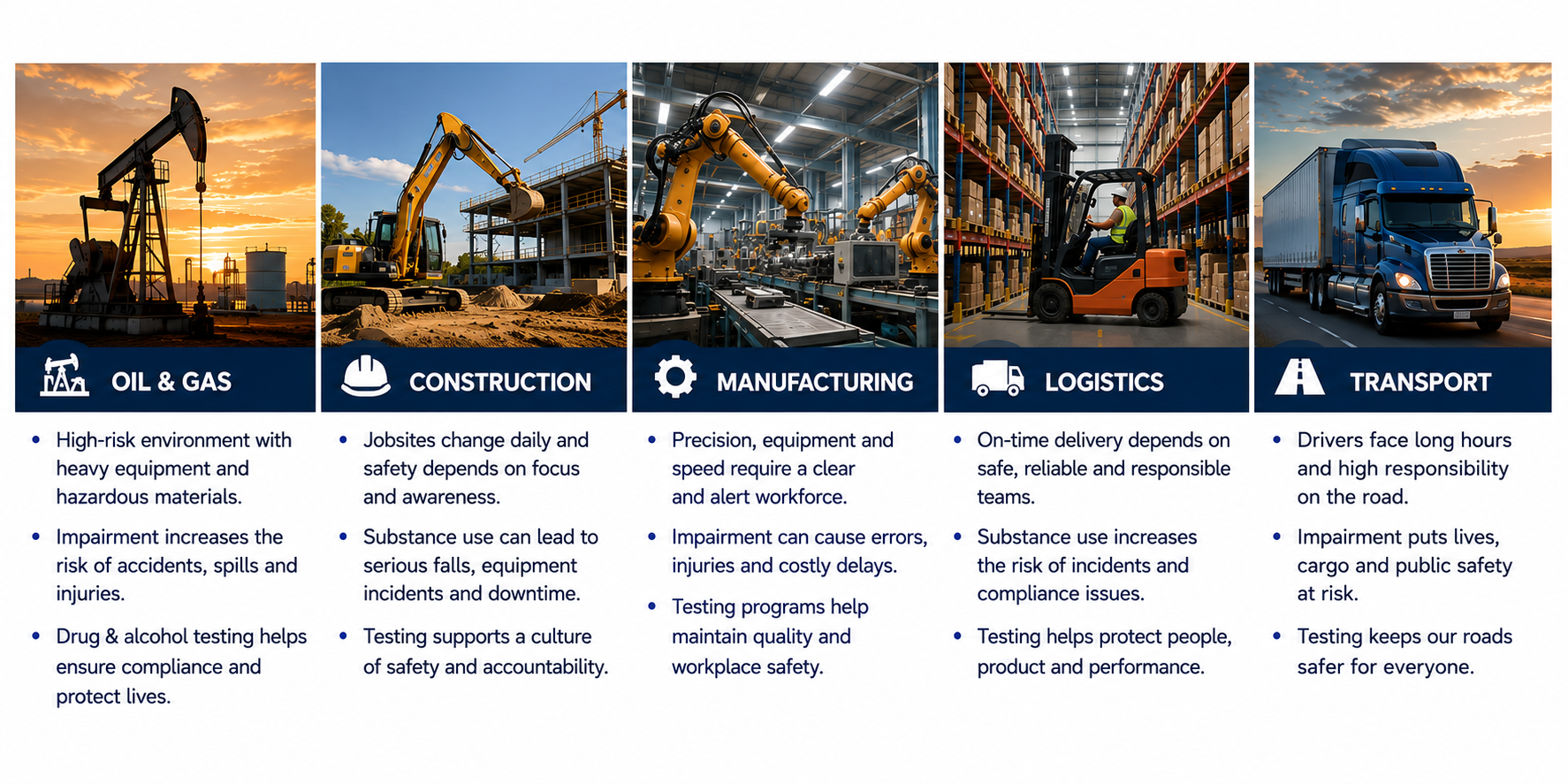
List of Industries served by Rapid Response, including DOT-regulated modes, field and mobile workforces, and industrial and OSHA-driven operations

DOT-regulated modes

  • Motor carriers & trucking (FMCSA)
  • Motorcoach & charter bus
  • School bus & student transport
  • Public transit & paratransit (FTA)
  • Rail & short lines (FRA)
  • Aviation & ground handling (FAA)
  • Pipeline operations (PHMSA)
  • Maritime & inland marine (USCG)
  • Hazmat transport
  • Ready-mix, aggregates & dump fleets
  • Refuse & roll-off haulers
  • Fuel & tanker distribution

Field & mobile workforces

  • Construction & heavy civil
  • Engineering, survey & geospatial
  • Electric utilities & line contractors
  • Gas, water & underground utilities
  • Telecom & tower crews
  • Oil, gas & field services
  • Environmental & remediation
  • Landscaping & tree services
  • HVAC, plumbing & electrical
  • Pest control & facility services
  • Last-mile, courier & delivery
  • Moving, storage & final mile
  • Towing & roadside assistance
  • Non-emergency medical transport
  • Municipal & public works fleets
  • Agriculture & custom harvesting

Industrial & OSHA-driven

  • Manufacturing & fabrication
  • Warehousing & distribution centers
  • Cold storage & food distribution
  • Forklift-heavy operations
  • Food & beverage processing
  • Ports, terminals & intermodal
  • Rail yards & switching
  • Mining & quarry operations
  • Staffing & industrial labor suppliers
  • PEOs & employers of record
  • Security & guard services
  • Hospitality & casino operations

Not on the list? If you have a written post-accident policy and people who move, the same gap applies. Ask us.

Every seat at the table

Who owns this, and why they sign

The title changes with company size. The 2 a.m. problem does not.

RoleWhat they're accountable forWhy Rapid Response
The regulated owner
Designated Employer Rep (DER)Receiving the incident call and making the testing decision. Required by DOT rule at every regulated employer.The determination and the collector get handled by someone awake, and the decision is documented.
Safety & compliance
Safety director / managerIncident procedure, driver qualification, audit readiness.A written 2 a.m. plan that survives an FMCSA audit, plus quarterly readiness reporting.
EHS manager / directorOSHA recordkeeping, incident investigation, post-incident policy.Uniform application of the policy, DOT and non-DOT sorted correctly at intake.
Compliance managerPart 40 and Part 382 conformance, MIS reporting.Chain of custody and MRO tracked to closure on every case.
Operations & fleet
Fleet manager / fleet safety managerVehicles, drivers and what happens when one is out of service.One number that also coordinates tow, recovery and scene documentation where available.
Operations / terminal managerKeeping the operation running while an incident unfolds.Supervisors stay with the incident instead of calling clinics.
Dispatch supervisorUsually the first person a driver actually reaches.A single escalation path, no judgment call required at 2 a.m.
People & risk
HR director / managerAt 50 to 500 employees, HR usually is the DER.Removes a compliance obligation nobody in HR was trained for.
Risk managerInsurance program, loss control, litigation exposure.A defensible record on every incident, whether or not a test was required.
Workers' comp / claims leadFirst reports of injury and claim defensibility.The testing decision is preserved and documented before the claim reaches an adjuster.
General counselDeposition and discovery exposure after a serious incident.Documented attempts instead of silent gaps.
Owner / principal / CFOEverything, at companies under 50 people.A $995 funded account removes a category of risk without changing the existing program.

Broker, workers' comp TPA, safety consultant or platform? Those relationships work differently. See partner options →

Rapid Response API

Your platform knows about the crash before anyone calls anyone

Telematics, ELD, dashcam AI, fleet management, claims and FNOL systems detect or receive the incident first. One endpoint turns that detection into a coordinated, documented response, without your team building a collector network or learning 49 CFR Part 40.

POST /incident · pilot
# Crash detected -> response begins
POST /incident
{
  "employer_id": "acct_9f2",
  "driver": { "name": "...", "phone": "..." },
  "vehicle_class": "CMV",
  "location": { "lat": 41.88, "lng": -87.62 },
  "occurred_at": "2026-07-27T02:14:00Z",
  "signals": { "tow_away": true, "injury": "unknown" }
}

# Returns
{
  "incident_id": "inc_4471",
  "applicability": "dot_post_accident_pending_citation",
  "clocks": { "alcohol_attempt_by": "04:14Z",
              "drug_collect_by": "10:14+1Z" },
  "collector": { "status": "confirming", "eta_min": 24 },
  "status_webhook": "https://..."
}
  • Applicability determinationDOT or non-DOT, against §382.303 and the employer's own policy. Not every incident requires a test. We make that call and document it either way.
  • Collector dispatchNearest qualified clinic or mobile collector, with a backup layer, benchmarked by county.
  • Clock trackingThe 2, 8 and 32-hour windows armed and monitored from the first timestamp.
  • Chain of custody and MROHandled end to end, results returned to your system.
  • Allied dispatch where availableHeavy tow and recovery, mobile repair, scene documentation and occupational clinic referral under one incident ID.
  • The recordOne structured incident packet your customer can attach to a claim file or hand to an auditor.
Pilot

Free to integrate

No setup fee, no annual license during the pilot. We earn when an incident is activated and services are dispatched. Requires a written pilot agreement, a defined fleet count and placement inside the crash workflow.

Embedded

Per-incident activation

An activation fee per coordinated incident plus the services actually dispatched, with an optional revenue share for the platform. The model once utilization is proven.

White-label

Your brand, our network

Partner-branded intake and status experience, annual minimum, custom SLA. For platforms and TPAs who want incident response as their own feature.

Integration is free during the pilot. Response is not: readiness, 24/7 intake and nationwide coordination carry real cost, and no model here depends on maximizing the number of tests performed.

Get started

Four doors. All of them take under two minutes.

01 · Employers

Activate your Rapid Response program

No subscription. Fund an account from $995, unlimited employees, live within days. We invoice, you register your company, we brief your supervisors, and your DER gets one number that works at any hour.

DER · EHS · Safety · Fleet · HR · Risk · Owner
Public agencies: see procurement details
Activate program
02 · Platforms

Start an API pilot

Tell us the platform, the fleet count, and where incident detection lives in your product. We send the pilot agreement and sandbox access.

Telematics · ELD · Dashcam AI · Fleet management · Dispatch · Claims & FNOL · Workers' comp platforms
Request pilot access
03 · Channel partners

Become a Rapid Response Partner

Refer it, co-brand it, or private-label it. Your clients get the 2 a.m. plan they don't have. You get a readiness report with your logo on it and advice that is finally executable.

Insurance brokers · Workers' comp carriers & TPAs · Safety consultants · PEOs · Occupational medicine networks · Drug-testing TPAs · Tow & roadside networks
Register as a partner
04 · Response providers

Join the response network

We dispatch to whoever actually answers. Tell us your coverage area and after-hours capability. Qualified providers get paid work routed to them when an incident lands nearby.

DOT-qualified collectors · Mobile collection services · Occupational clinics · Urgent care · Heavy tow & recovery · Roadside repair
Join the network
Public sector

Your drivers are DOT-regulated. Your nights are not covered.

School districts, transit authorities, county public works and municipal utilities run safety-sensitive drivers into hours when nothing is open. Rapid Response takes the incident and returns a documented record, without re-competing the testing contract you already have.

Most agencies set it up on a standard purchase order. W-9, insurance certificate and vendor forms come back the same day.

24/7 by phone, text or API. You pick the channel, we run the clock.

Public sector & procurement →
  • From $995  funded balance, not a subscription
  • FMCSA-registered  C/TPA, operating since 2003
  • 1.5M+ tests  past performance on the record
  • Capability statement  one page, sent on request

Drive for a company and want them to have this? Refer your employer and earn $100 →

FAQ

Frequently asked questions

Do we have to move our DOT program to you?
No. That is the point of the program. Your consortium, TPA, MRO and random pool stay exactly where they are. Rapid Response is standalone and only handles incidents.
Does every accident require a DOT test?
No. A fatality always triggers testing. Otherwise a qualifying outcome (injury treated away from the scene, or a vehicle towed due to disabling damage) must be combined with a citation issued to your driver. Everything beyond that is company policy. We make and document the determination at intake, which is exactly the call a supervisor gets wrong at midnight.
What happens if a window cannot be met?
The regulation requires documenting the attempts and the reasons, on time. We complete that documentation as part of the case. A documented attempt protects you; a silent gap does not.
What if there is no collector open nearby?
Every case carries a backup layer: mobile collectors and after-hours providers in addition to clinic coverage. If a qualified collector genuinely cannot be reached in time, the attempts and outcome are documented within the required window.
Do you cover non-DOT employees?
Yes, under your written policy. For non-DOT workers, post-incident testing is generally permissible where there is a reasonable possibility that drug use contributed, or under a uniformly applied policy or qualifying state workers' compensation provisions. Requirements vary by state, and we are not your legal counsel.
Can you run our full DOT program as well?
Yes, separately. US Health Testing runs complete DOT programs: pre-employment, random consortium pools, Clearinghouse queries, MRO services and policy. It is a different service with its own quote, and Rapid Response never requires it. Most Rapid Response customers keep the program they already have. If you want a quote, tick the box on the activation form.
How fast is the response?
Intake begins the moment you report. Our internal target is a qualified collector confirmed within 30 minutes, and we benchmark by region rather than promising a national number we cannot defend everywhere.

The next incident is already on the clock

We send the invoice, you register your company, we brief your supervisors. After that, one report is all your team ever has to do.

Activate your program

Sources & methodology

Counter methodology: no live national crash feed exists. The counter advances at the average rate implied by the most recent published annual figure (528,177 ÷ 365 ≈ 1,447 per day ≈ one every 0 seconds), reset at midnight local time. It is an estimate for illustration, not a report of specific incidents, and is updated when federal agencies publish new annual data.