5 Panel vs 10 Panel Drug Tests: Which Drug Test Should Employers Choose?
Introduction
Workplace drug testing plays a critical role in maintaining safety, productivity, compliance, and workforce reliability. Whether you’re hiring new employees, managing a safety-sensitive workforce, or developing a comprehensive drug-free workplace program, choosing the right drug test panel is an important decision.
One of the most common questions employers ask is:
Should we use a 5 panel drug test or a 10 panel drug test?
While both options are widely used across industries, they serve different purposes and offer varying levels of substance detection. Selecting the right panel depends on your industry, hiring goals, workplace risks, compliance requirements, and company policies.
In this guide, we’ll compare 5 panel and 10 panel drug tests, explain what substances they detect, discuss employer considerations, and help you determine which option is best for your organization.
What Is a Drug Test Panel?
A drug test panel refers to the number of drug categories screened during testing.
For example:
- A 5 panel drug test screens for five major drug classes.
- A 10 panel drug test screens for ten drug classes.
These tests are commonly performed using:
- Urine testing
- Hair testing
- Oral fluid testing
- Blood testing (less common for workplace screening)
Urine testing remains the most popular method for employer drug testing because it is cost-effective, accurate, and widely accepted.
What Does a 5 Panel Drug Test Screen For?
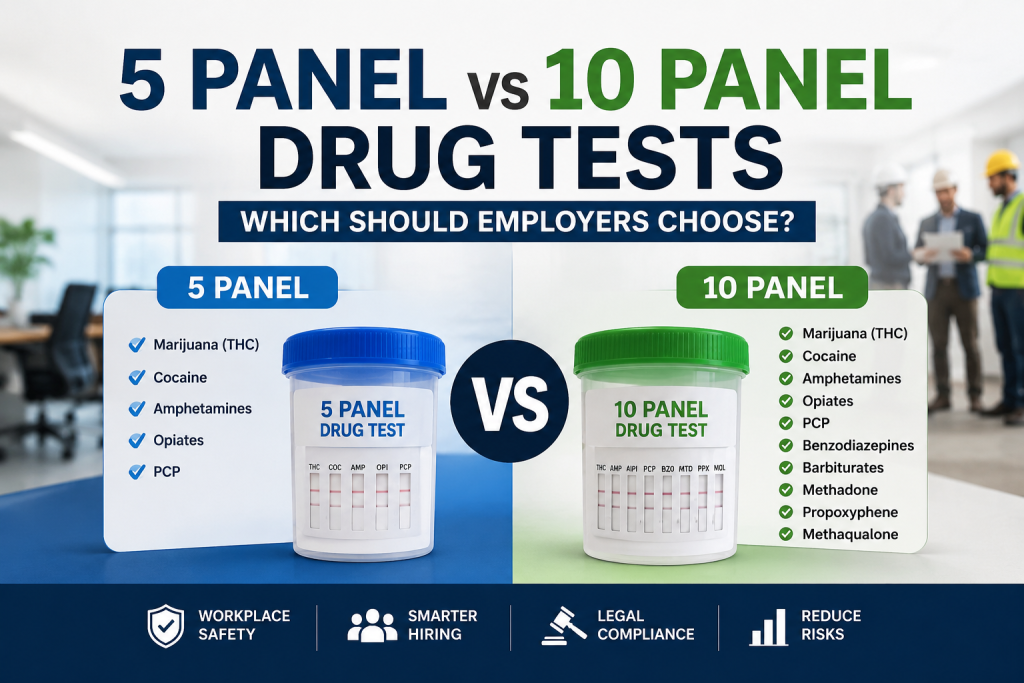
The standard 5 panel drug test typically screens for:
| Drug Category | Common Examples |
|---|---|
| Marijuana (THC) | Cannabis, marijuana products |
| Cocaine | Powder cocaine, crack cocaine |
| Amphetamines | Adderall, methamphetamine |
| Opiates | Morphine, codeine, heroin |
| PCP | Phencyclidine |
These substances have historically been among the most commonly abused drugs in the workplace.
The 5 panel test is often considered the baseline screening option for many employers.
What Does a 10 Panel Drug Test Screen For?
A 10 panel drug test includes all substances found in a 5 panel test plus additional drugs.
Typical substances screened include:
Included from the 5 Panel Test
- Marijuana (THC)
- Cocaine
- Amphetamines
- Opiates
- PCP
Additional Drugs Screened
- Benzodiazepines
- Barbiturates
- Methadone
- Propoxyphene
- Methaqualone (or other expanded substances depending on laboratory panel)
Many modern 10 panel tests may also include:
- Oxycodone
- Hydrocodone
- Hydromorphone
- Synthetic opioids
- Prescription sedatives
The exact drugs tested may vary by laboratory and testing provider.
Key Differences Between 5 Panel and 10 Panel Drug Tests
Detection Scope
The primary difference is the number of substances screened.
5 Panel Test
Focuses on:
- Common illicit drugs
- Traditional workplace concerns
- Basic pre-employment screening
10 Panel Test
Provides broader detection of:
- Prescription drug misuse
- Additional controlled substances
- Expanded workplace risk factors
Cost
5 Panel Drug Test
Generally:
- Lower cost
- Faster implementation
- Suitable for large-volume hiring
10 Panel Drug Test
Typically:
- Higher cost
- More comprehensive screening
- Better for higher-risk environments
While pricing varies, employers should view drug testing as a risk-management investment rather than simply an expense.
Workplace Risk Assessment
The level of workplace risk should influence panel selection.
Lower-Risk Environments
Examples:
- Administrative offices
- Remote workforces
- Customer service teams
- Clerical positions
A 5 panel test may be sufficient.
Higher-Risk Environments
Examples:
- Transportation
- Manufacturing
- Construction
- Warehousing
- Energy
- Healthcare
- Heavy equipment operations
A 10 panel test often provides greater protection.
Which Industries Commonly Use 5 Panel Drug Tests?
The 5 panel drug test is frequently used by:
- Retail employers
- Hospitality companies
- Call centers
- Corporate offices
- Staffing agencies
- Professional services firms
- Entry-level hiring programs
Organizations seeking an affordable and efficient pre-employment screening solution often choose a 5 panel test.
Which Industries Commonly Use 10 Panel Drug Tests?
The 10 panel test is often preferred by:
- Construction companies
- Transportation employers
- Logistics providers
- Healthcare organizations
- Manufacturing facilities
- Government contractors
- Utility companies
- Energy sector employers
These industries often face greater safety risks and liability exposure.
DOT Drug Testing Requirements
Many employers ask:
Does DOT Require a 5 Panel or 10 Panel Drug Test?
The U.S. Department of Transportation (DOT) requires a specific federally regulated testing panel.
DOT testing includes screening for:
- Marijuana metabolites
- Cocaine metabolites
- Amphetamines
- Opioids
- PCP
While similar to a traditional 5 panel test, DOT testing follows strict federal procedures and regulations.
Employers subject to DOT regulations must use DOT-compliant testing regardless of whether they use additional non-DOT panels.
Is a 10 Panel Drug Test Better Than a 5 Panel?
Not necessarily.
The “best” test depends on employer objectives.
Choose a 5 Panel Test If:
- You need standard pre-employment screening.
- You hire large numbers of employees.
- Budget is a major consideration.
- Positions involve lower workplace risk.
- Your drug policy focuses on major illicit substances.
Choose a 10 Panel Test If:
- Safety is a top concern.
- Employees operate vehicles or machinery.
- Prescription drug misuse is a concern.
- You work in highly regulated industries.
- You want broader substance detection.
Employer Questions About Marijuana Testing
One of the biggest changes affecting workplace drug testing is evolving marijuana legislation.
Many employers now ask:
Should THC Be Included?
The answer depends on:
- State laws
- Industry regulations
- Company policies
- Safety requirements
Many organizations are moving toward:
- 5 panel drug tests without THC
- Customized employer drug testing programs
- Position-specific screening policies
Employers should review state and local regulations before making policy decisions.
How Drug Testing Supports Workplace Safety
A well-designed drug testing program can help employers:
Reduce Workplace Accidents
Substance impairment increases the likelihood of:
- Vehicle accidents
- Equipment incidents
- Workplace injuries
Improve Productivity
Drug-free workplaces often experience:
- Higher performance
- Better attendance
- Reduced absenteeism
Lower Workers’ Compensation Costs
Fewer workplace incidents can help reduce:
- Claims
- Insurance costs
- Legal exposure
Protect Company Reputation
Maintaining a safe workplace helps protect:
- Customers
- Employees
- Business partners
- Brand reputation
Can Employers Customize Drug Test Panels?
Yes.
Many employers are moving beyond standard panels and choosing customized testing programs.
Examples include:
- 5 Panel without THC
- 9 Panel testing
- 10 Panel testing
- Expanded opioid panels
- DOT and non-DOT combinations
- Industry-specific testing programs
Customization allows organizations to balance compliance, hiring goals, and workplace safety.
Best Practices for Employers Choosing a Drug Test
Before selecting a panel, consider:
1. Evaluate Job Risk Levels
Ask:
- Will employees drive?
- Will they operate machinery?
- Could impairment create safety hazards?
Higher risk often justifies broader testing.
2. Review Industry Regulations
Determine whether federal, state, or client requirements influence testing protocols.
3. Consider Hiring Objectives
Overly restrictive testing may reduce candidate pools in competitive labor markets.
4. Maintain Consistency
Apply testing policies consistently across similar job categories.
5. Work With a Qualified Testing Provider
A reputable testing partner can help ensure:
- Regulatory compliance
- Nationwide testing access
- Accurate laboratory results
- Medical Review Officer (MRO) oversight
Final Thoughts
When comparing a 5 panel vs 10 panel drug test, there is no universal solution for every employer.
A 5 panel drug test offers a cost-effective and efficient screening option for many organizations, particularly those in lower-risk industries.
A 10 panel drug test provides broader substance detection and may be better suited for employers with safety-sensitive positions, regulatory concerns, or a desire for more comprehensive screening.
The right choice ultimately depends on your workforce, industry, hiring strategy, risk tolerance, and compliance obligations.
By aligning your drug testing program with your organization’s goals, employers can create safer workplaces, reduce liability, support compliance efforts, and make more informed hiring decisions.
References:
- https://www.drugs.com/medical-answers/what-10-panel-drug-test-what-detect-3579570/
- https://iccouncil.org/insights/what-is-a-dot-5-panel-drug-test/
- https://recovered.org/drug-tests/5-panel-drug-test
- https://www.transportation.gov/odapc/DOT_5_Panel_Notice_2018