What Happens If You Fail a Pre-Employment Drug Test?
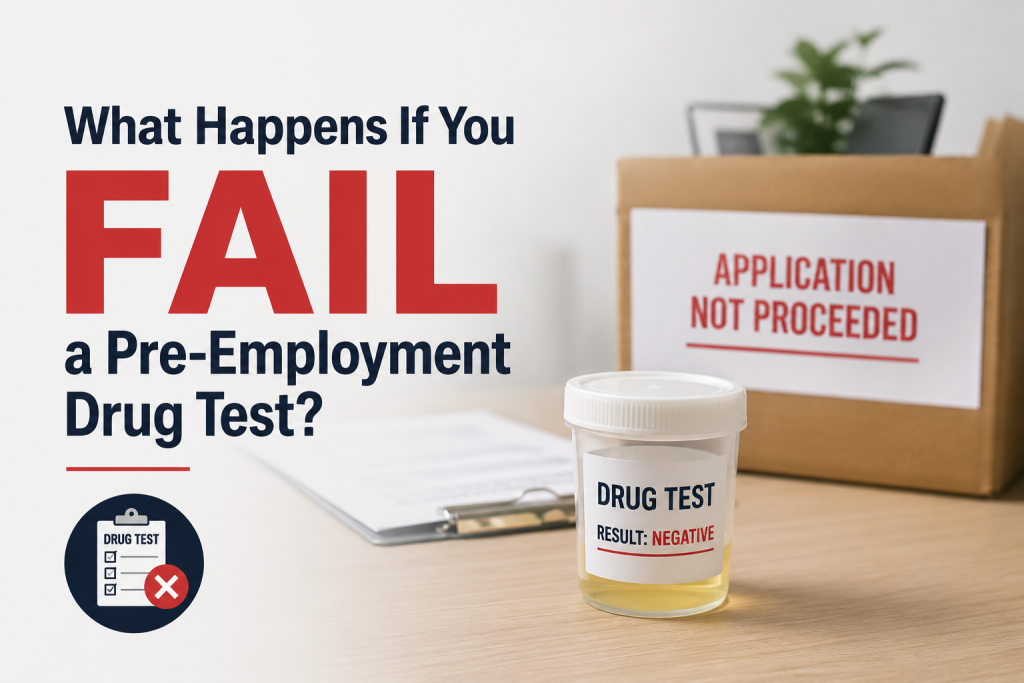
Landing a new job is exciting — until the employer asks you to complete a pre-employment drug test. For most candidates, it’s a routine formality. But for others, the question looms large: What actually happens if you fail?
Whether you’re an applicant who recently used a substance, an employer designing your testing policy, or an HR professional navigating a complicated situation, this guide covers everything you need to know — from what counts as a “failure” to your legal rights, next steps, and how to handle the process with confidence.
What Is a Pre-Employment Drug Test?
A pre-employment drug test is a screening conducted by an employer to detect the presence of illegal substances or the misuse of prescription medications in a job candidate’s system. Most employers require this test after extending a conditional job offer — meaning the offer depends on passing the test.
Standard pre-employment drug panels typically screen for:
- Marijuana (THC)
- Cocaine
- Amphetamines (including methamphetamine)
- Opiates (heroin, morphine, codeine)
- Phencyclidine (PCP)
This standard 5-panel drug test is the most common, though employers in safety-sensitive industries may use 10-panel or 12-panel screens that include additional substances like benzodiazepines, barbiturates, and methadone.
The most common testing method is urine testing, though some employers use oral fluid (saliva), hair follicle, or blood testing depending on what they need to detect and over what time window.
What Happens Immediately After You Fail a Drug Test?
Failing a pre-employment drug test doesn’t happen the moment you submit your sample. The process has multiple steps, and understanding each one can help you navigate the situation with clarity.
Step 1: Initial Positive Result at the Lab
Your urine or other sample is analyzed at a certified laboratory. If a substance is detected above the federally established cutoff level, the result is flagged as a “preliminary positive.” This does not yet count as a confirmed failure.
Step 2: Confirmation Testing
The same sample undergoes a second, more precise test — typically gas chromatography-mass spectrometry (GC-MS). This method confirms whether the substance is genuinely present and rules out false positives caused by certain foods, medications, or supplements.
Step 3: Medical Review Officer (MRO) Review
A certified Medical Review Officer (MRO) — a licensed physician trained in substance abuse — reviews the confirmed positive result. The MRO will contact you to ask whether you have a valid prescription or legitimate medical explanation for the positive result. This step is your opportunity to provide context before a final determination is made.
Step 4: Employer Notification
If no valid medical explanation exists, the MRO reports the result to the employer as a “verified positive.” At this point, the employer is formally notified that you have failed the drug test.
Important: A preliminary positive ≠ a failed test.
Confirmation testing and MRO review are critical safeguards. Always respond promptly to MRO contact — missing this step can result in an automatic failure even if you have a legitimate explanation.
Will You Lose the Job Offer?
In most cases, yes — a verified positive pre-employment drug test will result in the withdrawal of the conditional job offer. Employers are legally permitted to rescind job offers based on a failed drug test in most U.S. states.
However, the outcome depends on several factors:
- Industry and role:
- Safety-sensitive positions in transportation, healthcare, construction, or federal contracting have zero-tolerance policies and strict DOT/FMCSA regulations. A failure here is typically non-negotiable.
- Company policy:
- Some private employers have discretion and may consider the substance involved, the candidate’s role, or whether it was a first-time situation.
- State laws:
- A growing number of states have enacted cannabis protection laws that limit an employer’s ability to reject candidates solely based on off-duty marijuana use. States like California, New York, New Jersey, and others have varying protections.
Will It Go on Your Permanent Record?
This is one of the most common — and most misunderstood — questions. Here’s the truth: a failed pre-employment drug test is not reported to a government database or your permanent employment record in most cases.
However:
- DOT-regulated industries are an exception. The U.S. Department of Transportation maintains a Federal Motor Carrier Safety Administration (FMCSA) Drug and Alcohol Clearinghouse, which tracks violations for commercial drivers. Employers in these sectors are legally required to query this database before hiring.
- Some background check services include drug test results in their reports if the employer includes it in their scope.
- The employer who ran the test is permitted to retain the result internally and may disclose it to future employers if directly asked (and permissible under state law).
The practical concern isn’t a permanent government record — it’s that the same employer may flag you in their internal system and decline to consider you for future roles.
Can You Dispute or Retest After a Failed Drug Test?
Yes, and this is an important right that many applicants don’t know they have.
Request a Split Sample Retest
When your urine sample is collected, labs are required to collect a split sample — two portions from the same collection. If you believe your result is incorrect, you have the right to request that the second portion be tested at a different SAMHSA-certified laboratory. This must be requested within 72 hours of receiving the MRO’s notification.
Provide Documentation to the MRO
If you take a prescription medication that may have caused a positive result — such as prescribed amphetamines, opioids, or benzodiazepines — contact the MRO immediately with documentation from your prescribing physician. The MRO has the authority to reclassify the result as negative if a valid prescription is confirmed.
Check for Collection or Chain-of-Custody Errors
If you have reason to believe the sample was improperly collected, stored, labeled, or handled, this can be grounds to invalidate the result. Proper chain-of-custody documentation is a legal requirement, and any deviation can be challenged.
Pro tip: Always confirm that the collection site is SAMHSA-certified and that proper chain-of-custody procedures are followed at the time of your test. This protects you in the event of a dispute.
Legal Rights You Should Know
U.S. employment drug testing law is primarily governed at the state level, but several federal frameworks also apply. Here’s what you need to know:
Federal Law
- The Americans with Disabilities Act (ADA) protects individuals in recovery from drug addiction — but does not protect current illegal drug users.
- DOT regulations (49 CFR Part 40) govern all testing in safety-sensitive transportation roles and mandate SAMHSA-certified labs, certified collectors, and MRO review.
- Federal contractors and grantees must comply with the Drug-Free Workplace Act.
State Law
- Many states require employers to disclose their drug testing policies in writing before testing.
- Some states (e.g., California, New York) restrict marijuana-related adverse employment actions for off-duty use.
- Certain states require that employees in non-safety-sensitive roles be given a chance to seek treatment rather than face immediate termination.
If you believe your employer violated your rights during the drug testing process, consulting an employment attorney in your state is advisable.
How Long Should You Wait Before Reapplying?
This depends entirely on the employer’s policy. Some companies have mandatory waiting periods — commonly 6 months to 1 year — before a candidate who failed a pre-employment drug test can reapply. Others may permanently disqualify candidates from specific roles.
If you’re planning to reapply:
- Confirm the employer’s reapplication policy directly with HR.
- Allow sufficient time for the substance to clear your system, accounting for the detection window of the specific substance.
- Consider proactively demonstrating commitment to sobriety or compliance, especially for safety-sensitive roles.
Common Reasons for Unexpected Positive Results
Not every positive result is the result of recreational drug use. Some of the most common causes of unexpected positives include:
- Prescription medications (opioids, ADHD medications, sleep aids, anxiety medications)
- CBD products containing trace amounts of THC
- Poppy seeds, which contain trace opiates
- Some cold medicines and decongestants that may flag for amphetamines
- Second-hand smoke exposure (though this is increasingly rare with modern cutoff thresholds)
If any of these apply to you, communicate with the MRO before the review is finalized. Proactive disclosure with documentation is always the right move.
Order Your Pre-Employment Drug Test Online — Same Day Sample Submission
US Health Testing makes pre-employment drug testing simple, fast, and confidential.
Whether you’re an employer screening candidates or a job seeker who wants to verify your status before an upcoming test, US Health Testing offers a fully online ordering process backed by a nationwide network of SAMHSA-certified collection sites — partnered with Labcorp and Quest Diagnostics.
Here’s how it works: Order online in minutes. Choose from 5-panel, 10-panel, DOT, or other panel types. Receive your lab requisition instantly. Walk into any nearby participating collection site and submit your sample the same day. Results are typically available within 24–48 hours.
No appointment necessary at most locations. No waiting weeks for results. Just a straightforward, professional process that gets you the information you need — fast.
Whether you’re proactively checking your own status, building a compliant workforce, or simply need a fast turnaround before a job start date, US Health Testing is built for exactly this. Visit ushealthtesting.com to get started today.
Tips for Employers: Building a Fair and Compliant Drug Testing Policy
If you’re an employer reading this, a well-structured drug testing policy protects your organization, your employees, and your liability exposure. Best practices include:
- Apply testing consistently across all candidates for the same role — inconsistent testing creates legal risk.
- Put your drug testing policy in writing and ensure candidates are informed before an offer is extended.
- Always use SAMHSA-certified laboratories and MRO-reviewed results — never make employment decisions based on unconfirmed preliminary positives.
- Stay current with state marijuana laws, which continue to evolve rapidly.
- Partner with a trusted provider like US Health Testing to streamline ordering, scheduling, and results delivery.
Frequently Asked Questions
Can I fail a drug test for taking prescribed medication?
A confirmed positive for a substance covered by a valid prescription should not result in a final “failure” after MRO review — provided you disclose your prescription and provide documentation. Always be upfront with the MRO.
Does marijuana use always result in a failed pre-employment test?
Marijuana is detectable in urine for up to 30 days in heavy users. Whether a positive for marijuana results in disqualification depends on employer policy, the role, and the state. Some states now restrict adverse employment actions for off-duty cannabis use.
Can an employer share my failed drug test with other employers?
In most industries, no. However, DOT-regulated sectors are required to report violations to the FMCSA Clearinghouse, and future employers must query that database before hiring commercial drivers.
How quickly can I get my results?
With US Health Testing, most standard drug test results are available within 24 to 48 hours after sample submission. Same-day testing is available at thousands of locations nationwide — order online and submit your sample the same day.
Final Thoughts
Failing a pre-employment drug test is serious — but it doesn’t have to be the end of the road. Understanding the process, knowing your rights, and responding appropriately at each stage can make a real difference in the outcome.
For job seekers: be honest with the MRO, know your state’s laws, and — if needed — allow adequate time for substances to clear before your next opportunity.
For employers: a fair, consistent, and legally compliant drug testing program protects everyone. Partnering with a trusted, SAMHSA-certified testing provider like US Health Testing ensures your program meets federal and state standards while delivering fast, reliable results.
Ready to get started? Visit ushealthtesting.com to order a pre-employment drug test online, choose your panel, and submit your sample the same day at a location near you.
Disclaimer: This article is for informational purposes only and does not constitute legal advice. Drug testing laws vary by state and industry. Consult a qualified employment attorney for guidance specific to your situation